International Centre for Environmental Information Management (ICEIM)
Vision: A world where environmental sustainability is driven by accessible, reliable, and actionable information for all.
Mission: To serve as the global nexus for the collection, standardization, analysis, and dissemination of environmental data. We empower governments, businesses, researchers, and the public with the knowledge needed to make informed decisions for a sustainable planet.
International Centre for Environmental Information Management (ICEIM)
Vision: A world where environmental sustainability is driven by accessible, reliable, and actionable information for all.
Mission: To serve as the global nexus for the collection, standardization, analysis, and dissemination of environmental data. We empower governments, businesses, researchers, and the public with the knowledge needed to make informed decisions for a sustainable planet.
Core Objectives
The objectives of ICEIM are designed to address the entire information lifecycle, from data collection to actionable insight.
1. Data Acquisition & Harmonization
- Establish and maintain a global network for collecting environmental data (e.g., air/water quality, biodiversity, climate metrics, soil health) from satellites, IoT sensors, government agencies, research institutions, and citizen science initiatives.
- Develop and promote international standards and protocols for environmental data formatting, metadata, and quality control to ensure interoperability and reliability.
2. Information Management & Technology
- Build and manage a secure, scalable, and cloud-based global data repository that serves as a trusted source for historical and real-time environmental information.
- Leverage advanced technologies, including AI, machine learning, and big data analytics, to process complex datasets, identify trends, and generate predictive models.
3. Knowledge Dissemination & Accessibility
- Develop user-friendly digital platforms (portals, dashboards, APIs) that provide tailored access to data for diverse audiences, from scientists to schoolchildren.
- Publish regular reports, policy briefs, and interactive maps that translate complex data into clear, actionable insights on critical environmental issues.
4. Capacity Building & Partnerships
- Provide training, technical assistance, and resources to nations and organizations, especially in developing regions, to enhance their own environmental information management capabilities.
- Foster a collaborative global community by partnering with UN agencies, NGOs, academic networks, and private sector entities to avoid duplication and maximize impact.
5. Policy Support & Decision-Making
- Provide robust, evidence-based analysis and customized information products to support international environmental agreements (e.g., Paris Agreement, UN SDGs, Post-2020 Global Biodiversity Framework).
- Develop tools that enable policymakers and businesses to model the potential environmental outcomes of different decisions and strategies.
Organizational Structure
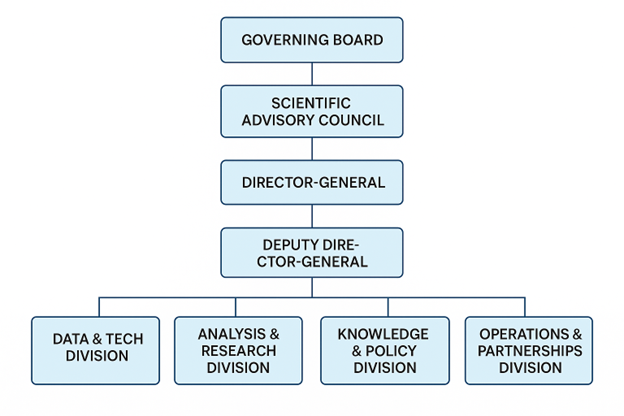
The proposed structure is designed to be agile, collaborative, and focused on delivering the Centre’s objectives effectively.
Governance & Oversight
Governing Board: Representatives from key funding governments, leading scientific bodies (e.g., UNEP, WMO), renowned academic institutions, and civil society. Sets strategic direction, approves budget, and ensures accountability.
Scientific Advisory Council: Independent experts in environmental science, data science, economics, and policy. Provides guidance on research priorities, methodological rigor, and ethical standards.
Executive Leadership
Director-General: Chief executive officer, responsible for overall leadership, management, and external representation of ICEIM.
Deputy Director-General: Supports the DG and oversees integration of the Centre’s operational divisions.
Core Operational Divisions
1. Division of Data & Technology
Function: The technical backbone of the Centre.
- Department of Data Acquisition & Integration: Manages data sourcing, ingestion pipelines, and partner agreements.
- Department of Data Standards & Quality: Develops standards, validates incoming data, ensures consistency.
- Department of IT & Cyber Infrastructure: Manages data centers, cloud platforms, security, and networking.
- Department of Software & Application Development: Builds and maintains data portals, APIs, and analytical tools.
2. Division of Analysis & Research
Function: Transforms raw data into knowledge and insights.
- Department of Climate & Atmosphere: Focuses on GHG emissions, temperature, weather patterns, and climate modeling.
- Department of Ecosystems & Biodiversity: Analyzes species populations, habitat loss, deforestation, and ocean health.
- Department of Pollution & Resources: Tracks air/water/soil pollution, waste management, and freshwater resources.
- Geospatial Analysis Unit: Specializes in GIS, remote sensing, and cartography to create maps and spatial models.
3. Division of Knowledge & Policy
Function: Bridges the gap between data and the end-user.
- Department of Communications & Public Engagement: Manages website, social media, media relations, and outreach.
- Department of Reporting & Publications: Produces annual reports, assessments, and policy briefs.
- Department of Policy Support: Provides customized data analysis for policy development.
4. Division of Operations & Partnerships
Function: Ensures smooth running of the Centre and builds its global network.
- Department of Capacity Building & Training: Organizes workshops, develops online courses, and provides technical support.
- Department of Partnership Development: Cultivates and manages relationships with governments, NGOs, academia, and private sector.
- Department of Finance & Administration: Handles HR, budgeting, logistics, and daily operations.
ICEIM Country Chapters: Localizing Global Environmental Intelligence
Concept: ICEIM Country Chapters are semi-autonomous national units that act as the local arm of the global ICEIM organization. Their primary purpose is to adapt the Centre’s global mission to national and sub-national contexts, ensuring that global data is locally relevant and that local data contributes to the global repository.
Vision: To be the nationally recognized and authoritative hub for environmental information, driving evidence-based decision-making at all levels within the country.
Mission: To champion the principles of ICEIM within the nation by facilitating the collection, standardization, and sharing of domestic environmental data, building local capacity, and ensuring the country’s environmental story is accurately represented on the global stage.
Core Objectives of a Country Chapter
National Data Sovereignty & Integration:
- Create a unified national environmental data repository by aggregating data from ministries, research institutions, NGOs, and private companies.
- Ensure nationally collected data adheres to ICEIM’s international standards for global integration.
Localized Analysis & Reporting:
- Analyze global and national datasets to produce country-specific reports and insights (e.g., biodiversity assessments, city-level air quality reports, soil health maps).
Stakeholder Engagement & Capacity Building:
- Serve as a neutral platform for government agencies, academia, industry, and community groups to collaborate on environmental information projects.
- Organize training workshops and develop educational materials to strengthen national capacity in data collection, analysis, and monitoring.
Policy Support & Public Engagement:
- Provide timely, evidence-based environmental information to policymakers to support legislation, regulations, and planning.
- Translate complex environmental data into accessible formats for the media, educators, and the public.
Representation & Advocacy:
- Represent the country’s environmental data interests within the global ICEIM network.
- Advocate for open, standardized environmental information as a public good.
Organizational Structure of a Country Chapter
The structure mirrors the global ICEIM model but is scaled for national operations and integrated with local institutions.
Governance:
National Advisory Board: Chaired by a respected national figure (e.g., a former minister, renowned scientist). Includes representatives from ministries (Environment, Science, Agriculture, Energy), leading universities, NGOs, and private sector associations. Provides strategic direction, ensures legitimacy, and helps secure funding.
Leadership:
Country Director: Nationally recruited leader with expertise in environmental science, data management, and diplomacy.
Chapter Coordinator: Manages day-to-day operations, administration, and project timelines.
Core Functions: (small core team leveraging partnerships)
- Data Liaison & Management Officer: Links the Chapter with national data providers, negotiates sharing agreements, and validates data against standards.
- Policy & Outreach Officer: Engages policymakers, manages communications, media relations, and dissemination.
- Capacity Building & Training Officer: Develops training programs, workshops, and manages the “ICEIM Fellows” program.
- Technical Analyst: Supports data analysis, links with ICEIM’s global cloud, and maintains IT infrastructure.
Establishment and Affiliation Process
- Expression of Interest: Submitted by a consortium of national institutions (e.g., university, government agency, NGO).
- Feasibility Assessment: ICEIM evaluates data landscape, stakeholders, and potential hosts.
- Memorandum of Understanding (MoU): Formal agreement outlining roles, responsibilities, and funding commitments.
- Launch: Appointment of a Country Director and formation of the National Advisory Board.
Funding Model
Mixed Funding: Chapters develop sustainable financing through:
- Core funding from host institutions or national governments.
- Project grants from international agencies and foundations.
- Technical service contracts with private sector entities.
- Limited startup support from ICEIM headquarters.
This ensures ICEIM is not a distant body but an embedded, relevant, and empowering force within each member nation.